 |
|
|
|
|
|
|
|
|
|
|
|
|
|
|
|
|
|
|
|
|
|
|
|
|
|
|
|
|
|
|
|
|
|
|
|
|
|
|
|
|
|
|
|
|
|
|
|
|
|
|
|
|
|
|
|
|
|
|
|
|
|
|
|
|
|
|
|
|
|
|
|
|
|
|
|
|
|
|
|
|
|
|
|
|
|
|
|
|
|
|
|
|
|
|
 |
|
|
|
|
 |
|
 |
|
|
|
|
|
|
|
|
|
|
|
|
|
|
|
|
 |
|
|
|
|
|
|
|
 |
|
|
|
|
|
|
|
|
|
|
|
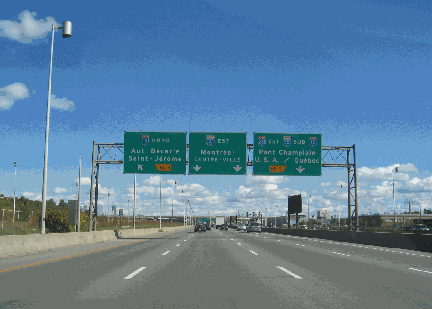
This 2006 photo shows the Guy Lafleur Autoroute (A-50) approaching EXIT 292 (A-15 / Laurentian Autoroute) in Mirabel. A-50 ends about 500 meters (one-quarter mile) east of A-15 at QC 117, but the province had plans to extend A-50 east to A-31 in Joliette and beyond. (Photo by Laura Siggia-Anderson.)
|
|
|
|
|
|
|
|
|
 |
|
|
|
|
 |
|
|
|
|
|
|
|
|
|
158.3 kilometers (98.4 miles)
1970-2012
|
|
|
|
|
|
|
|
|
|
|
|
|
|
 |
|
|
|
|
|
A LINK FOR THE OUTAOUAIS REGION: The first mention of a proposed autoroute between Montreal and the Ottawa-Gatineau region - via the north shore of the Ottawa River - dates back to 1962 when Oswald Parent, a Liberal Party member in the National Assembly of Quebec from 1956 to 1976 serving the Hull riding. The proposed Montreal-to-Hull autoroute failed to gain much traction as the emphasis was on building a freeway directly connecting Montreal with Ottawa via Autoroute 40 and Ontario Highway 417, which was built over a 12-year period from 1963 to 1975.
|
|
|
|
|
|
|
|
|
|
|
|
|
|
|
|
|
|
|
|
|
The first formal studies for the "Autoroute d'Outaouais" (Ottawa Valley Autoroute) date back to 1967, when the Conseil Economique de l'Ouest du Quebec (Western Quebec Economic Development Council). The council saw the need to furnish a modern, high-speed link between the Hull-Gatineau area and Montreal's northern suburbs. The proposed freeway would bypass two-lane Route 8 (now QC 148), which the council thought was unable to address future traffic demand. There were numerous studies undertaken since then advocating for the freeway's construction, as long-distance traffic had to pass through the center of each locality along the north shore of the Ottawa River, creating obstacles, delays, and potential safety concerns.
MIRABEL SEALS THE DEAL: In 1969, after a year of studying as many as 20 different sites stretching from Vaudreuil-Dorion to the west and Drummondville to the east, as well as heated disagreements, the Federal and provincial governments reached an agreement to build a new international airport in Saint-Scholastique, an agricultural town approximately 60 kilometers (37 miles) northwest of Downtown Montreal.
The proposed Mirabel Airport, for which 39,250 hectares (97,000 acres) were expropriated by the Federal government, was designed to be Canada's premier air hub that would take it into the supersonic jet age. Taking inspiration from Dallas-Fort Worth (DFW) International Airport, whose construction began around this time, Mirabel Airport was to have six runways and 14 semi-circular terminals; there was also a provision for a seventh landing strip for vertical takeoff-and-landing (VTOL) aircraft.
According to AirportHistory.org, the Mirabel Airport site was challenged by its relative lack of transportation options, notably the absence of a nearby commuter rail line and the sole reliance on a single controlled-access highway (A-15 / Laurentian Autoroute). To remedy this, the joint Federal-provincial report called for the construction of the following routes:
|
|
|
|
|
|
|
|
|
|
|
|
An east-west route along the southern perimeter of the airport property connecting A-15 to the east with the Ottawa-Gatineau region. This eventually became known as Autoroute 50.
|
|
|
|
|
|
|
 |
|
|
|
|
|
|
 |
|
|
|
|
|
A north-south route paralleling the existing A-15 (Laurentian Autoroute) connecting the southern boundary of Mirabel Airport with Dorval (now Pierre Trudeau) Airport, Montreal, and the South Shore. This eventually became known as Autoroute 13, or the Chomedey Expressway. A 22-kilometer (14-mile)-long section of A-13 from A-20 (Remembrance Highway) north to A-640 (North Belt Autoroute) between 1973 and 1975, but the northern extension to Mirabel Airport was never built.
|
|
|
|
|
|
|
|
|
|
|
|
|
|
|
|
|
 |
|
|
|
|
|
The runways and terminals were to have been divided by a controlled-access spine road, much like International Parkway (TX 97 Spur) serves the terminals at DFW Airport. It was to be built with four lanes initially, but have right-of-way set aside to expand the road to eight lanes in the future. The province did not assign a designation for this spine road, but a hypothetical designation for this freeway could have been A-450 (this was a short-lived designation in the Gatineau area for what later was re-designated A-550, perhaps to free the A-450 designation for this route), as it would have been a through traffic / loop designation from the A-50 mainline.
|
|
|
|
|
|
|
|
|
|
|
|
|
|
The Mirabel Airport master plan also called for a construction of a rapid transit loop line, called "TRAMM" (Transport Rapide Regional Aeroportuaire Montreal-Mirabel), connecting the airport with Downtown Montreal. Designed for speeds of up to 160 km/h (100 MPH), the TRAMM line was to have been routed along the spine road, serving each terminal. The TRAMM system was planned for completion in 1980, but disagreements between the Federal and provincial governments killed the rapid transit line.
Although key parts of the Mirabel Airport transportation network were never built, the decision by the Federal and provincial governments to build the airport still provided a key catalyst for the province's plans for a Montreal-to-Gatineau autoroute.
|
|
|
|
|
|
|
|
|
 |
|
|
|
|
|
 |
|
|
|
|
|
|
|
|
|
|
|
This 1969 master plan for Mirabel Airport illustrates the proposed highway network serving the airport complex, including the southern bypass route (Autoroute 50) and the internal spine road (shown here as a hypothetical A-450). Not shown on this map is Autoroute 13 (Chomedey Expressway), which was planned to split from A-50 just south of the airport property. (Original map supplied by AirportHistory.org; modified by Steve Anderson.)
|
|
|
|
|
|
|
|
|
|
|
|
|
|
|
|
|
|
|
|
PLANNING IN THE GATINEAU REGION: In the summer of 1970, the provincial government and the National Capital Commission, a regional planning organization comprised of officials from both Quebec and Ontario, began negotiations for developing a 72-kilometer (45-mile) freeway network in the Hull-Gatineau region. That year, in one of his last acts as Quebec Premier, Jean-Jacques Bertrand formally announced plans for the Autoroute d'Outaouais between the Hull-Gatineau region, Mirabel Airport, and Greater Montreal. In January 1971, the proposed Ottawa Valley autoroute had a new designation: Autoroute 50.
|
|
|
|
|
|
|
|
|
|
|
|
|
|
The 72-kilometer freeway network proposed by the Quebec government and the National Capital Commission, of which Autoroute 50 was a key component, was to comprise the following routes per the province's 1971 autoroute planning map:
Autoroute 50: Beginning at Chemin Eardley (Eardley Road) in Aylmer (Gatineau), A-50 was to continue east along Boulevard des Allumettieres (formerly known as St. Lawrence Boulevard and Route 8, now QC Route 148) past Gatineau Park towards Brewery Creek, where it was to veer north along an alignment parallel to the creek. The four-lane "Brewery Creek Expressway" ("Autoroute du Ruisseau de la Brasserie") was to continue north for eight kilometers (five miles) towards Davidson Corner, including a new bridge over the Gatineau River, then veer east towards Masson The Ministere de la Voirie du Quebec (MVQ) was to reveal plans for the autoroute east of Masson at a later date.
|
|
|
|
|
|
|
|
|
|
|
|
Autoroute 450 (later A-550): Beginning at Davidson Corner, Autoroute 450 - alternatively called the "Gatineau Park Autoroute" ("Autoroute du Parc de la Gatineau") and the Deschenes Autoroute ("Autoroute Deschenes") - was to continue west roughly along the Hydro-Quebec right-of-way, cross the Gatineau River at a new bridge, and have an interchange with Autoroute 5 near kilometer-post 10. It was to continue west through Gatineau Park for about three kilometers (two miles), then turn south through the area of Gatineau Park Golf Course. It was to cross the Ottawa River on a new bridge near the Descenes Rapids, touching down in Ontario near Brittania Beach and continuing south as Ontario Highway 416.
|
|
|
|
|
|
|
|
|
|
|
|
|
|
|
|
|
|
Autoroute 5: Continuing north from the existing north-south autoroute at St. Joseph Boulevard (current EXIT 5), Autoroute 5 ("Autoroute Gatineau") was to extend an additional 30 kilometers (19 miles) north to QC 105 in Wakefield, about one kilometer (0.6 mile) north of the current terminus at QC 105 / QC 366.
The proposed autoroutes were to have a speed limit of 60 MPH (97 km/h) within Hull city limits, and a 70 MPH (113 km/h) outside city limits.
On January 8, 1972, the Quebec government and the National Capital Commission reached an agreement to build the three autoroutes as part of a six-year, C$130 million plan to relieve congestion and address future traffic. At that time, work already had started in October 1971 on the Brewery Creek Expressway, while the MVQ began location studies for the route between Masson and Mirabel.
|
|
|
|
|
|
|
|
|
|
|
|
|
|
|
 |
|
|
|
|
|
|
|
|
This 1971 map shows the initial alignments and route designations for the autoroute network in the Hull-Gatineau region. By the time the "Brewery Creek Expressway" section was completed, the province had swapped designations: A-50 was assigned to the Gatineau Park-Deschenes corridor, while A-550 was assigned to the Brewery Creek-Davidsons Corner alignment (the A-450 designation was deleted here). The A-50 and A-550 designations were swapped once again in 1992. (Map © 1971 by Ministere de la Voirie du Quebec.)
|
|
|
|
|
|
|
|
|
 |
|
|
|
|
|
|
|
|
"No one can claim any direct paternity--or maternity?--over Highway 50. It took multiple interventions over several decades to overcome each of the obstacles, large and small, that arose over the years." -- Columnist Pierre Jury in a 2012 article published in Le Droit
|
|
|
|
|
|
|
|
|
|
|
|
THE FIRST SECTION - MIRABEL BOULEVARD: Early work at the Mirabel Airport site began in 1970. The first section of A-50 on which work began and was completed, was initially called "Mirabel Boulevard" (Boulevard Mirabel). In its ultimate configuration, it was to be an eight-lane spine road serving multiple terminals at the airport, but was initially built with only four lanes. A wide grassy median east of the airport hints at the potential for a wider spine road.
|
|
|
|
|
|
|
 |
|
|
|
|
|
|
|
|
|
|
As originally configured, Mirabel Boulevard had two interchanges: one at A-15 (modified cloverleaf interchange), and the other at the airport's passenger and freight terminals (modified trumpet interchange, with a left-hand exit from the westbound lanes). West of the terminal interchange, Mirabel Boulevard narrowed to two lanes and ended at a T-intersection with St. Simon Road (Chemin St.-Simon).The Mirabel Boulevard spine road was opened to traffic with the airport in October 1975, but did not carry the A-50 designation until 1995, when the road was extended west of the airport.
BUILDING BREWERY CREEK: Work began on a three-kilometer (two-mile)-long segment through Gatineau in 1971 on the Brewery Creek segment from A-5 (Gatineau Autoroute) north / east to QC 148 (Maloney Boulevard). Although the original plans called for construction of a four-lane freeway along the Brewery Creek alignment, the initial section featured six through traffic lanes, as well as a new bridge over the Gatineau River. Official maps published during construction of the Brewery Creek segment did not show a designation, though it did show this segment as under construction - and did not show the Gatineau Park-Deschenes bypass at all - likely demonstrating that the province prioritized construction of the Brewery Creek Expressway.
|
|
|
|
|
|
|
|
|
|
|
|
When the Brewery Creek segment opened in 1976, this segment received a new designation - Autoroute 550 - to identify a spur leading to Downtown Hull (now Gatineau). At this time, the Autoroute 50 designation was switched to the Gatineau Park-Deschenes alignment west of Davidson Corner.
|
|
|
|
|
|
|
 |
|
|
|
|
|
|
|
|
|
|
THE LACHUTE BYPASS: Beginning in 1975, the Ministere des Transports du Quebec (MTQ) began work on a 6.3-kilometer (3.9-mile)-long segment of Autoroute 50 as a bypass of Lachute, a manufacturing town about 28 kilometers (17 miles) west of Mirabel Airport. The A-50 Lachute bypass was built as a four-lane freeway with opposing traffic flows separating by a concrete ("Jersey") barrier for most of this segment. The Lachute bypass, which extended from current EXIT 254 (QC 148) east to EXIT 260 (QC 329), was completed in 1977, and was the first segment between Gatineau and Mirabel to receive signs for Autoroute 50.
FROM HULL TO MASSON: After several years of environmental studies and pre-construction activities, the MTQ began work in 1983 on a 27.2-kilometer (16.9-mile)-long freeway extension from EXIT 139 (QC 148) in Hull (Gatineau) east to EXIT 166 (QC 315) in Masson. Designed as a four-lane freeway with a variable-width grassy median, this section is notable for the curve at Davidson Corner near kilometer-post 142, where there was to have been an interchange with the Gatineau Park-Deschenes Autoroute, which at the time was designated A-50. When the Hull-Masson section opened in 1986, the southernmost section from Hull to Davidson Corner was designated A-550, after which point (i.e., the unbuilt Davidson Corner interchange) the A-50 designation appeared eastward to Masson.
A SHORT SOUTHERN EXTENSION: In 1988, the MTQ opened a short 1.8-kilometer (1.1-mile)-long, four-lane extension of the Brewery Creek segment south of A-5, bypassing the existing T-interchange with A-5. The extension includes a grade-separated interchange at QC 148 (Boulevard des Allumettieres) and ends about 300 meters (1,000 feet) south of QC 148 at a signalized intersection with Montcalm Street. This project was completed in conjunction with work by the National Capital Commission to clean up and refurbish the adjacent Brewery Creek, as well as build a pedestrian and bicycle trail along the creek.
|
|
|
|
|
|
|
|
|
|
|
|
|
|
 |
|
 |
|
|
|
|
|
|
|
|
|
|
|
These photos taken in 2012 (left photo at EXIT 135 / Autoroute 5; right photo at EXIT 134 / QC 148) show the westbound A-50 (Guy Lafleur Autoroute) as it approaches its western terminus at Montcalm Street in Gatineau. There are no current plans to extend A-50 westward. (Photos by Valerie Deane, www.nysroads.com.)
|
|
|
|
|
|
|
|
|
|
|
|
|
|
|
|
|
|
|
|
|
|
|
|
|
|
|
|
|
|
STILL A LONG WAY TO GO: By the end of the 1980s, only about 45 kilometers (28 miles) of Autoroute 50 had been completed, namely the Gatineau, Lachute, and Mirabel segments. Even as MTQ began to study the A-50 corridor as early as 1972, and expropriate property as early as 1976, a couple of new obstacles faced A-50 in the second half of the 1970s.
|
|
|
|
|
|
|
|
|
|
|
|
|
|
First, Parti Quebecois (PQ), which was elected into power in 1976, implemented an eight-year moratorium on new autoroute construction in the province, with work limited to autoroutes that already were under construction. Second, Quebec became the first province to implement environmental review studies in 1978, through what is now known as a BAPE (Bureau d'audiences publiques sur l'environnement) study. New infrastructure projects in the province now had to undergo rigorous environmental studies as part of the planning process.
Even after the province ended its eight-year moratorium on autoroute construction in the mid-1980s, finding funds for the construction of A-50 still proved difficult. Nevertheless, the MTQ began planning for the lifting of the moratorium in 1981, when it filed a notice with the Quebec Ministry of the Environment (MENVIQ) to obtain authorization of the construction of A-50 from Masson east to Lachute. In 1982, MENVIQ issued the directive that would guide preparation of the environmental impact study.
In 1987, the MTQ conducted an opportunity to examine the construction of A-50 and A-13 in the Montreal-Mirabel-Hull corridor, and determine the most optimal way to build this corridor. This report presented A-50 and A-13 as projects intended to support regional economic development objectives, and examined four possible scenarios for A-50 between Masson and Mirabel as follows:
Simple rehabilitation of QC 148 with passing lanes.
Widening QC 148 to four lanes, either divided or undivided (with bypass lanes around developed areas).
Construction of an autoroute (A-50) on a new right-of-way consisting of one two-lane roadway.
Construction of an autoroute (A-50) on a new right-of-way consisting of two median-separated roadways, each carrying two lanes.
The study concluded that, to ensure efficient regional service, as well as improve the level and service and safety for users, construction of A-50 with two carriageways and grade-separated interchanges appeared to be the most appropriate solution. Although the planners of A-50 sought early on to build a dual-carriageway freeway, budgetary constraints instead prompted the construction of "super 2" segments from Masson to the western end of the four-lane Lachute Bypass, and from the Lachute Bypass east to four-lane Mirabel Boulevard.
|
|
|
|
|
|
|
|
|
 |
|
|
|
|
 |
|
|
|
|
|
|
|
|
This map from Transport Quebec's 1988 environmental impact study for A-50 from Lachute east to Mirabel. Although the study found strong advantages with the southern alignment (3) if Mirabel Airport were to be more successful, it recommended the central alignment (2) as it offered a combination of serving existing airport infrastructure while preserving the existing QC 158 corridor. There was a wye divering from alignment (2) near the current A-50 at kilometer-post 275 for a future extension of A-13. Map © 1988 by Ministere des Transports du Quebec.
|
|
|
|
|
|
|
|
|
|
|
|
|
|
|
|
|
|
|
|
FROM LACHUTE TO MIRABEL: By the 1980s, the ambitious expectations for Mirabel Airport had already begun to fade as more long-haul international flights originating in Canada shifted to Toronto's Pearson International Airport, removing a key purpose for Mirabel. Nevertheless, provincial planners continued to view A-50 and A-13 as key components of a broader transportation corridor linking Montreal and the Outaouais region. The objectives outlined in the MTQ's opportunity study reflected this shift toward regional mobility and economic development.
|
|
|
|
|
|
|
|
|
|
|
|
|
|
The objectives pursued by the Autoroutes 13 and 50 project were as follows:
To connect major centers (Hull, Lachute, and Montreal) in order to increase and strengthen their economic ties.
To consolidate an existing development corridor by accelerating and improving communications in order to encourage the development of the region's tourist and recreational attractions.
To respond to travel demand along the road corridor under study. This demand includes two types of traffic: 1) long-distance traffic; and 2) regional traffic (between the various municipalities located along the study corridor).
To remedy the deficiencies of the existing road link (Route 148) in terms of geometric design and traffic conditions, namely 1) for all types of traffic, limited passing visibility, the high density of roadside activity, and the large number of access points along the route; 2) for long-distance traffic, the need to pass through the center of each locality located on the north shore of the Ottawa River, with all the obstacles and delays this entails; and 3) for automobile traffic, the constraining presence of a significant number of heavy vehicles, many of them trucks serving the timber transport industry.
To make a larger portion of Quebec's territory more easily accessible to Quebecers.
In 1988, the MTQ published an environmental impact study on the Lachute-to-Mirabel segment. Starting from the eastern end of the Lachute Bypass (EXIT 260 / QC 329), there were three alternative alignments heading east towards Mirabel Airport.
ALTERNATIVE 1: From the eastern end of the Lachute Bypass, A-50 was to continue in a northeasterly direction towards QC 158 near the Golf le Select golf course. From there, A-50 was to continue east along QC 158 and the southern shoreline of Riviere du Nord before turning southeasterly towards Mirabel Boulevard.
ALTERNATIVE 2: From the eastern end of the Lachute Bypass, A-50 was to continue in an easterly direction towards QC 148 near Sainte-Scholastique (Mirabel), then veered northeasterly towards the intersection of St. Simon Road and Mirabel Boulevard, at which point A-50 would continue along Mirabel Boulevard. A provision was made just east of QC 148 for a wye to split off from A-50 for a future A-13 extension.
ALTERNATIVE 3: From the eastern end of the Lachute Bypass, A-50 was to continue in a southeasterly direction past QC 148 towards the southern end of the Mirabel Airport property, where there was to be an interchange with a future A-13 extension. Although the 1988 BAPE map did not show this, this alternative would have featured a new interchange with A-15 (possible EXIT 32 on the Laurentian Autoroute), similar to the original Mirabel Airport master plan, with the existing Mirabel Boulevard serving as the spine road serving the airport.
Planners immediately rejected Alternative 1 as it provided less service to the Mirabel Airport property and had a greater potential negative impact on existing villages and farmland. Planners also appeared to favor Alternative 3 as it not only avoided existing villages, but also had the potential to provide more service to the airport (in conjunction with the Mirabel Airport spine road / potential A-450) in event that Mirabel Airport was expanded. As the 1990s approached, however, this seemed a remote and fading possibility. Ultimately, planners decided on an alignment closest to Alternative 2, which was a compromise that delivered a direct route to Mirabel Airport via Mirabel Boulevard while minimizing disruptions to both nearby villages and farmland.
The Lachute-Mirabel section of A-50 was originally planned as a four-lane, dual-carriageway freeway, but budgetary considerations led to its construction as an undivided "super 2" freeway. Moreover, unlike most controlled-access highways, there are two at-grade railroad crossings - one near kilometer-post 268, the other near kilometer-post 277 - along this section.
Work on the Lachute-Mirabel section began in 1993. The first part of this section, from EXIT 272 (QC 148) east to EXIT 280 (St. Simon Road) in Mirabel, was completed in 1995; upon its completion, the existing Mirabel Boulevard section connecting to A-15 was designated A-50. The second part of this section, from EXIT 260 (QC 329) in Lachute east to EXIT 272, was completed in 1998, provided a direct controlled-access route from Lachute to Autoroute 15.
|
|
|
|
|
|
|
|
|
|
|
|
|
|
 |
|
|
|
|
|
|
|
|
This map from the 1992 A-50 BAPE study for the Masson-Montebello segment shows that multiple corridors were studied until a final agreement was reached on a new alignment inland from QC 148. (Map © 1992 by the Ministere des Transports du Quebec.)
|
|
|
|
|
|
|
|
|
 |
|
|
|
|
|
|
|
|
This map from the 1992 A-50 BAPE study for the Montebello-Lachute segment shows that A-50 would remove as much as 80% of through traffic from QC 148, based on projected levels from 1987. By the 2020s, traffic counts (AADT) through this segment were in the 15,000-20,000 range. (Map © 1992 by Ministere des Transports du Quebec.)
|
|
|
|
|
|
|
|
|
|
|
|
|
|
|
|
|
|
"The section of Route 148 in the Papineau RCM (Regional County Municipality) is not suited for long-distance travel and, therefore, for a national highway, mainly because of the numerous villages it crosses. Outside these areas, Route 148 is currently not used to its full capacity. Based on forecast increases in traffic, certain sections of this highway will reach their capacity around 2011." - Transports Quebec (1994)
|
|
|
|
|
|
|
|
|
|
|
|
FROM MASSON TO LACHUTE: Despite completion of the Lachute-Mirabel segment in 1995, large gaps still remained in the Autoroute 50 corridor between Masson and Lachute. For more than a decade afterward, Route 148 continued to carry most traffic between the Outaouais region and the Laurentians.
|
|
|
|
|
|
|
|
|
|
|
|
|
|
|
|
|
|
In 1992, the MTQ issued two separate environmental impact statements for the Masson-Montebello and the Montebello-Lachute segments, which together totaled 88.4 kilometers (54.8 miles). Even at the dawn of the decade, the final alignment for A-50 had yet to be decided as there was still debate over whether a parallel route (to QC 148) or an inland route. These environmental studies, along with subsequent studies in the mid-1990s, determined that an inland route was more suitable for building A-50. Nevertheless, the alignment of A-50 - specifically the northward jog from kilometer 169 in Masson-Angers to kilometer 176 in L'Ange Gardien - reflects the evolution of the project. Although the project parameters called for the construction of a four-lane, dual-carriageway freeway, budgetary constraints ultimately dictated that A-50 would be built as a "super-2" (one lane in each direction) for the complete length of the 88-kilometer gap.
Archaeological investigations undertaken along the corridor indicate that construction began around 2001 on an eight-kilometer (five-mile) segment from EXIT 166 (QC 315) in Masson east to EXIT 174 (QC 309 / Chemin Doherty) in Thurso. The completion of the Masson-Thurso section in 2004 marked the first segment of A-50 to open in the Outaouais region in nearly two decades.
In 2005, work began on a 12.7-kilometer (7.9-mile)-long section of Autoroute 50 from EXIT 174 in Thurso (QC 309) east to EXIT 187 (QC 309) in L'Ange Gardien, extending the "super-2" freeway into Papineau County. Also in 2005, construction began on a 14.6-kilometer (9.1-mile)-long section from the western end of the Lachute Bypass at EXIT 254 (QC 148) in Lachute west to EXIT 239 (QC 344) in Grenville-sur-la-Rouge. The openings of these sections within two weeks of each other in the fall of 2008 were part of a broader acceleration of construction across the Outaouais region, with multiple segments underway as the province worked to complete the long-delayed corridor between Gatineau and Lachute. These projects also marked the first time construction advanced simultaneously from both ends of the remaining gap.
Even as these sections were completed, the MTQ accelerated work to close the 53.2-kilometer (33.0-mile)-long gap between Thurso and Grenville-sur-la-Rouge. In chronological order, the MTQ completed this gap section by section as follows:
August 19, 2011: A 13.4-kilometer (8.3-mile)-long section opened from EXIT 226 (Chemin Avoca) east to EXIT 239 (QC 344) in Grenville-sur-la-Rouge.
October 28, 2011: A 16.1-kilometer (10.0-mile)-long section opened from EXIT 210 (QC 323) in Notre-Dame-des-Bonsecours east to EXIT 226 (Chemin Avoca) in Grenville-sur-la-Rouge.
August 15, 2012: A 5.9-kilometer (3.7-mile)-long section opened from EXIT 205 (QC 321) in Papineauville east to EXIT 210 (QC 323) in Notre-Dame-des-Bonsecours. The completion of this section included a short four-lane divided section in the area of EXIT 210.
November 26, 2012: A 17.8-kilometer (11.0-mile)-long section opened from EXIT 187 (QC 317) in Thurso east to EXIT 205 (QC 321) in Papineauville.
The completion of the last section in 2012 marked a half-century from the time that Autoroute 50 was first proposed as a direct Montreal-to-Gatineau link serving the north shore of the Outaouais region.
|
|
|
|
|
|
|
|
|
 |
|
|
|
|
 |
|
 |
|
|
|
|
|
|
|
|
These photos from 2007 (left photo) and 2009 (right photo) show Autoroute 50 under construction in the Grenville-sur-la-Rouge area. (Photos by Luc Jacques Cayen, from the Grenville-sur-la-Rouge Facebook group.)
|
|
|
|
|
|
|
|
|
|
|
|
|
|
|
|
|
|
|
|
SAFETY IMPROVEMENTS AND TWINNING EFFORTS: Although Autoroute 50 was completed as a continuous route in 2012, much of the corridor was constructed as a two-lane "super-2" facility built along a right-of-way designed for future expansion. While this approach allowed the province to complete the long-delayed corridor at lower cost, it also introduced operational and safety challenges, particularly as traffic volumes increased along the route. In the years following completion, the MTQ undertook a series of targeted improvements, including the addition of passing lanes and the gradual conversion of key segments to full four-lane, divided freeway standards.
|
|
|
|
|
|
|
|
|
|
|
|
|
|
In the early 2020s, the MTQ completed two twinning projects totaling approximately 16 kilometers (10 miles) of widening:
2022-2024: Twinning from kilometer-post 168.0 in Masson east to kilometer-post 177.5 in L'Ange-Gardien.
2023-2025: Twinning from kilometer-post 277.5 east to kilometer-post 284.0 in Mirabel.
In addition to these twinning projects, the MTQ also undertook several operational and safety improvements along Autoroute 50:
In the mid-2000s, the Autoroute 50 alignment near Montr�al-Mirabel International Airport was modified as part of a project involving the construction of a new trumpet interchange at boulevard Henri-Fabre (EXIT 288). Archaeological investigations conducted for the A-50 / Henri-Fabre project indicate that this work involved disturbance of previously undeveloped right-of-way, suggesting a realignment of the roadway. As part of this project, the eastbound carriageway was shifted toward the center of the right-of-way, replacing an earlier offset configuration that had anticipated future widening of the Mirabel Airport spine road.
In 2016, the MTQ removed two at-grade intersections serving the Mirabel Airport industrial park at Helen Bristol Street and Louis-Bisson Street. These intersections, whose movements were governed by a flashing yellow light on A-50 and a flashing red light on the side streets, were eliminated in preparation for a future widening project.
According to the MTQ, average traffic counts (AADT) along key sections of Autoroute 50 as of 2024 were as follows:
Gatineau (Brewery Creek): 105,000
Gatineau (Davidson Corner): 60,000
Gatineau (Bellevue District) to Masson: 45,000
Masson to L'Anse Gardien: 20,000
L'Anse Gardien to Lachute: 15,000
Lachute to Mirabel: 25,000
Mirabel Airport: 35,000
The evolution of Autoroute 50 reflects both the ambition and the constraints that shaped Qu�bec's postwar highway program. Conceived in the 1960s as a high-speed link supporting regional development and the proposed Mirabel Airport hub, the corridor took more than four decades to complete. When the autoroute was finally opened as a continuous route in 2012, much of it reflected the compromises of its long gestation, with extended "super-2" segments built in place of the originally envisioned divided freeway. In the years since completion, the MTQ has undertaken a program of incremental improvements -- targeted twinning, interchange upgrades, and the elimination of at-grade conflicts -- to enhance safety and capacity along the route. Today, Autoroute 50 continues to evolve, balancing its dual roles as a regional development corridor and a strategic link between the Montreal and Gatineau regions. As traffic volumes continue to grow, the long-term vision of a fully divided autoroute across the Outaouais region remains an open and active question for planners, subject to evolving priorities and available funding.
HONORING A HOCKEY GREAT: On May 4, 2023, the Commission de Toponymie du Quebec renamed Autoroute 50 in honor of Guy Lafleur, whose career in the National Hockey League (NHL) spanned nearly two decades, most of which was spent with the Montreal Canadiens. Lafleur was among the most prolific scorers in NHL history, and among his many awards as a player, he is best known for his contributions to the Canadiens' five Stanley Cups.
|
|
|
|
|
|
|
|
|
|
|
|
|
|
 |
|
|
|
|
|
This 2010 photo shows Autoroute 50 looking east from the Kilmar Road overpass at EXIT 233 in Grenville-sur-la-Rouge. Note the wide right-of-way for construction of a future second carriageway. (Photo by Scott Steeves, www.asphaltplanet.ca.)
|
|
|
|
|
|
|
|
|
|
|
 |
|
|
|
|
|
This 2010 photo shows Autoroute 50 looking west from the at-grade railroad crossing near kilometer-post 277 in Mirabel. This is one of two at-grade railroad crossings along A-50. Buses and hazmat trucks are required to pull over to the shoulder prior to approaching the railroad crossings. (Photo by Scott Steeves, www.asphaltplanet.ca.)
|
|
|
|
|
|
|
|
|
|
|
 |
|
|
|
|
|
|
|
|
|
 |
|
|
|
 |
|
|
|
 |
|
 |
|
|
|
|
|
|
|
|
A TALE OF TWO EXTENSIONS: These map snippets from the 1971 MVQ autoroute planning map shows the eastern terminus of A-50 at Saint-Gabriel (left map, shown in yellow), and potential study of a western extension of A-50 from Aylmer to Quyon (right map, shown in light blue). (Map © 1971 by Ministere de la Voirie du Quebec.)
|
|
|
|
|
|
|
|
|
|
|
|
|
|
|
|
|
|
|
|
EXTENDING EAST TO JOLIETTE AND BEYOND: In its 1971 province-wide autoroute planning map, the Ministere de la Voirie du Quebec (MVQ) proposed an extension of Autoroute 50 towards Autoroute 25 (Lanaudiere Autoroute) in Saint-Esprit and at Autoroute 31 (Antonio Barrette Autoroute) in Joliette. This map also indicated that A-50 was to extend northeast beyond Joliette to the Saint-Gabriel area. While some broader planning concepts may have envisioned a further extension of A-50 toward the St. Lawrence River towards Autoroute 40 near Berthierville, the Saint-Gabriel terminus represents the eastern limit of the route as defined in the province's formal autoroute plans of that period.
|
|
|
|
|
|
|
|
|
|
|
|
|
|
Although some planning-era maps show autoroute corridors extending as far as Berthierville, these alignments are associated with Autoroute 51, a separate proposed route linking Sorel-Tracy to Berthierville via a new St. Lawrence River crossing. By contrast, the 1971 autoroute planning map indicates that the eastern extension of Autoroute 50 terminated inland near Saint-Gabriel, reinforcing that A-50 and A-51 were distinct components of Qu�bec's broader highway planning framework.
Work began in 1973 on a two-lane highway on new right-of-way linking Saint-Esprit with Joliette, and by 1976, a 26.8-kilometer (16.6-mile)-long corridor was opened to traffic. The route received signs for Autoroute 50, and although there are some autoroute-like characteristics, like collector-distributor roads (C/D) at the A-31 interchange in Joliette and partial control of access, this "super-2" highway has at-grade intersections.
East of Joliette, the province purchased rights-of-way along Route 131 and an existing rail alignment for a future extension of A-50 towards Saint-Gabriel. Although the Ministere des Transports du Quebec (MTQ) had abandoned this corridor by 1979, the right-of-way was reused for a twinning of QC 131 (Joliette Bypass).
The cancellation of the Autoroute 50 extension east of Mirabel in early 1980s led to the removal of A-50 signs on the Saint-Esprit-to-Joliette segment; subsequently, this segment became known as Route 158. However, as traffic counts along this section of QC 158 have risen to about 20,000 vehicles per day (AADT) by the mid-2020s, up from about 15,000 in the mid-2010s, it is possible that the Ministere des Transports du Quebec (MTQ) may revisit this corridor and potentially add a second carriageway, if not necessarily resurrecting A-50.
Some local officials are seeking to do just that. In 2022, Marc Bourcier and Guy Lamothe, the respective mayors of Saint-Jerome and Sainte-Sophie, proposed an extension of Autoroute 50 from A-15 in Mirabel east to A-25 in Saint-Esprit to keep heavy trucks out of the towns the line QC 158. According to Le Journal du Nord, the MTQ told these mayors that budgetary constraints precluded an extension of A-50. The existing QC 158 carries about 15,000 vehicles per day (AADT) from Mirabel east to Sainte-Sophie, and about 10,000 AADT from Sainte-Sophie east to Saint-Esprit; these totals have relatively steady over the past decade.
|
|
|
|
|
|
|
|
|
|
|
|
|
|
 |
|
|
|
|
|
This 1975 MTQ map shows the "super-2" section of Autoroute 50 -- now signed as QC 158 -- between Saint-Esprit and Joliette. The A-50 designation was removed from this section in the early 1980s. (Map © 1975 by Ministere des Transports du Quebec.)
|
|
|
|
|
|
|
|
|
|
|
|
 |
|
|
|
|
|
|
|
|
This undated planning model (likely dating to the early 1970s) illustrates the proposed alignment of Autoroute 50 south of Joliette, including a cloverleaf interchange with Autoroute 31. Contemporary planning sources indicate that the route would have followed the present-day Route 158 corridor before bypassing Joliette and continuing north toward Saint-Gabriel-de-Brandon, demonstrating that the eastern extension of A-50 had progressed to an advanced design stage before its cancellation in the late 1970s.(Source: Transportologie, original model likely prepared by the Ministere de la Voirie du Quebec.)
|
|
|
|
|
|
|
|
|
|
|
|
|
|
|
|
|
|
|
|
EXTENDING WEST TO ALYMER: The official plans submitted by the province and the National Capital Commission in the early 1970s show that Autoroute 50 was to continue west from the existing Brewery Creek section along Boulevard des Allumettieres (QC 148), ending at Chemin Eardley (Eardley Road) in Aylmer (Gatineau). The original plan for the segment between Brewery Creek and Gatineau Park featured a depressed freeway with cross streets crossing the autoroute on overpasses, similar to the Decarie Expressway (A-15) in Montreal.
|
|
|
|
|
|
|
|
|
|
|
|
|
|
Although Autoroute 50 was never built along the Boulevard des Allumettieres corridor, the completion of this arterial corridor provided direct connection between Aylmer and the Alexandra Bridge. Nevertheless, the expropriation of properties for this arterial beginning in 1972 was controversial, particularly in the more established areas of Wrightville and Ile de Hull, which according to CBC News led to the relocation of 225 properties in these areas. The alignment of the roadway connecting the Hull section (St. Lawrence Boulevard) to the east with the Aylmer section (McConnell-Laramee Boulevard / Boulevard de l'Outaouais) to the west via Gatineau Park was criticized by environmentalists, who were more successful in stopping construction of the Gatineau Park-Deschenes Autoroute (A-550).
Major construction of the arterial, which included grade-separated interchanges at St. Raymond Boulevard, Gatineau Parkway, and Lac-de-Fees Parkway, began in 2003 and was completed in 2007. The speed limit along this corridor is 70 km/H (43 MPH) west of Gatineau Park, but east of Gatineau Park, where roundabouts were built at Labelle Street, Demontigny Street, and St. Joseph Boulevard, the speed limit is reduced to 50 km/h (31 MPH). Given the province's emphasis on creating a pedestrian-friendly boulevard that can accommodate bus stops, it appears highly unlikely that Autoroute 50 will be extended west along the Boulevard des Allumettieres corridor.
AND POSSIBLY BEYOND: The 1971 autoroute planning map published by the MVQ distinguishes between defined "future autoroutes," shown as yellow dotted lines, and broader transportation corridors, depicted as shaded blue bands. In several cases, including the A-50 corridor, these shaded bands extend beyond the limits of the planned autoroute network, suggesting that provincial planners were considering longer-range extensions that had not yet been formally incorporated into the autoroute system.
In the case of Autoroute 50, the Aylmer-to-Quyon section of existing QC 148 was considered by the MVQ as worthy of future study. Moreover, the current exit numbering scheme for A-50, which begins at EXIT 143 (QC 148 / Boulevard des Allumettieres), suggests a potential extension as far west as Pembroke, Ontario. However, few surviving sources clearly identify this corridor as part of A-50.
|
|
|
|
|
|
|
|
|
|
|
|
|
|
|
|
|
|
|
|
|
|
|
 |
|
|
|
|
|
SOURCES: "Hull Residents To Have Say on 'Plan'" by Dan Karon, The Ottawa Citizen (7/13/1971); "Western Quebec Freeway in Four Years," The Buckingham Post (11/15/1971); Numbering of Quebec Highways: Current and Projected Network, Ministere de la Voirie (1971); "Six-Year Plan To Rejuvenate Hull," The Montreal Gazette (1/21/1972); "Autoroute 50," The Buckingham Post (1/21/1972); "L'Autoroute 25 Est a Nos Portes" by Martial Coderre, L'Horizon (6/06/1973); "Rapid Rail System May Link City, Mirabel by 1980" by Luana Parker, The Montreal Gazette (3/27/1974); Jonction Entre l'Autoroute 550 et le Boulevard St.-Laurent: Rapport Complementaire a l'Etude d'Impact sur I'Environnement, Ministere des Transports du Quebec (1983); Etude d'Opportunite Portant sur la Construction des Autoroutes 13 et 50 dans I'Axe Montreal-Mirabel-Hull, Ministere des Transports du Quebec (1987); Etude d'Impact sur I'Environnement: Autoroute 50, Troncon Lachute-Mirabel, Ministere des Transports du Quebec (1988); Etude d'Impact sur I'Environnement: Autoroute 50, Liaison Routiere Lachute-Masson, Troncon Lachute-Montebello, Ministere des Transports du Quebec (1992); Etude d'Impact sur I'Environnement: Autoroute 50, Liaison Routiere Lachute-Masson, Troncon Montebello-Masson, Ministere des Transports du Quebec (1992); Inventaires Archeologiques (Ete 2002), Direction des Laurentides-Lanaudiere, Direction Generale de Montreal et de l'Ouest, Ministere des Transports du Quebec (2003); "Autoroute 50: Ouverture du Contournement du Secteur Buckingham" (press release); Transport Canada (12/08/2024); "Un Nouveau Troncon de l'Autoroute 50 Inaugure" by Yves Soucy, Le Droit (11/10/2008); "Un Nouveau Troncon de la 50 Ouvert en Grande Pompe" by Jean-Francois Dugas, Le Droit (8/20/2011); "Ouvertue du Dernier Troncon de l'Autoroute 50," CBOFT-TV (11/27/2012); "Enfin la 50!" by Pierre Jury, Le Droit (11/27/2012); "'It Was Really Alive': Remembering the Razing of McConnell-Laramee" by Krystallie Ramiakhan, CBOT-TV (2/09/2019); "Highway 50 To Be Fully Enlarged Within 10 Years, Quebec Says" by Michel Saba, The Montreal Gazette (3/14/2022); "Autorout 50 Part of More Than $400 Million Announced for Highway Projects Across Laurentides" by James Morgan, The Review (4/13/2024); "L'Autoroute Que Personne N'Aime Emprunter" by Caroline Touzin, La Presse (7/05/2024); "Autoroute 50: Une Mauvaise Nouvelle et Une Grande Deception pour des Elus" by Charles Lelande, CBOFT-TV (6/04/2025); "Autoroute 50: Une Trentaine d'Accidents Mortel Depuis 2019," CHOT-TV (12/12/2025); AirportHistory.org; Transportologie; Scott Steeves.
A-50, A-13, and A-550 shields by Wikipedia.
A-450 shield by Steve Anderson.
Lightpost photos by Steve Anderson.
|
|
|
|
|
|
|
|
|
|
|
|
|
|
|
|
|
|
|
|
|
|
|
|
|
|
|
|
|
|
|
|
|
|
|
|
|
|
 |
|
|
|
|
|
GUY LAFLEUR AUTOROUTE VIDEO LINKS:
A-50 (Dan Murphy)
A-50 (Scott Steeves)
|
|
|
|
|
|
|
|
|
|
|
|
 |
|
|
|
|
|
THE EXITS OF METRO MONTREAL:
Autoroute 50 exit list by Steve Anderson.
|
|
|
|
|
|
|
|
|
|
|
 |
|
|
|
|
|
|
|
|
|
|
|
|
Site contents © by Eastern Roads. This is not an official site run by a government agency. Recommendations provided on this site are strictly those of the author and contributors, not of any government or corporate entity.
|
|
|
|
|
|
|
|
|
|